

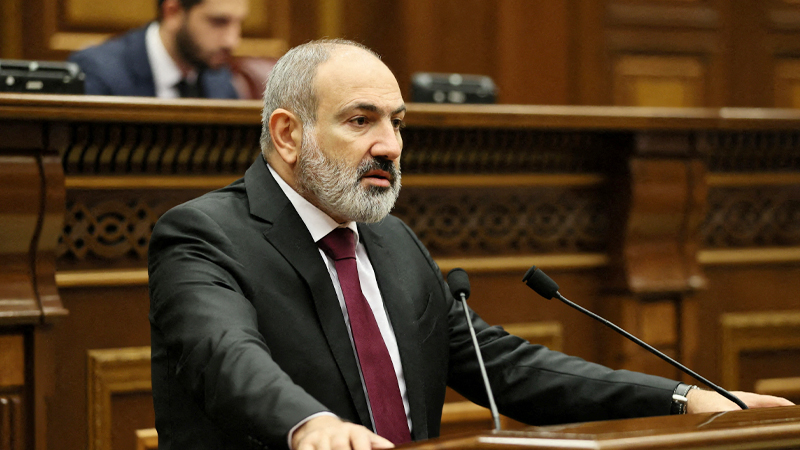
Armenia’s Prime Minister Nikol Pashinyan confirmed on Wednesday that his country plans to exit the Collective Security Treaty Organization (CSTO), marking a significant shift in the region’s geopolitical landscape and escalating tensions with Moscow.
The CSTO, a Russia-led alliance of former Soviet states, is designed to provide mutual defense in the event of an attack. However, Pashinyan criticized the organization for failing to protect Armenia, particularly in light of recent conflicts with Azerbaijan.
‘We Won’t Come Back,’ Armenian PM Declares
“We will leave,” Pashinyan stated unequivocally during an address to lawmakers. “We will decide when to leave. We won’t come back, there is no other way.” He accused CSTO members of aligning with Azerbaijan, which launched a military offensive in September to seize control of the Nagorno-Karabakh region, ending decades of ethnic Armenian separatist rule. “It turned out that its members failed to fulfill their obligations under the treaty and planned the war against us alongside Azerbaijan,” Pashinyan added, without providing further details.
Mixed Diplomatic Signals
Despite the prime minister’s strong statements, Armenia’s Foreign Minister Ararat Mirzoyan clarified that a full withdrawal had not yet been formally announced. “Those who assert that the prime minister said that Armenia is withdrawing from the CSTO are mistaken,” Mirzoyan said. The Kremlin has not yet responded to the latest developments.
Armenia’s relationship with Russia has deteriorated since Moscow refused to intervene in the Nagorno-Karabakh conflict. Russia previously acted as a guarantor of a peace deal that ended a 44-day war with Azerbaijan over the disputed territory three years ago. Despite this, Azerbaijan’s superior military forces succeeded in capturing the region.
In February, Armenia further distanced itself from Russia by joining the International Criminal Court (ICC), which has issued an arrest warrant for Russian President Vladimir Putin over his actions in Ukraine. Since then, Putin has avoided visiting ICC member states.
Protests in Yerevan
Domestically, Armenia has experienced ongoing anti-government protests, with thousands gathering outside the parliament to oppose land concessions to Azerbaijan. Clashes with police on Wednesday resulted in dozens of injuries among demonstrators.
Last month, Armenia handed back four border villages, seized decades ago, to Azerbaijan. Pashinyan defended this move as a necessary step towards securing peace. Both countries have been negotiating a peace treaty and working on demarcating their heavily militarized 1,000-kilometer (625-mile) shared border.
As Armenia navigates its exit from the CSTO and its complex relationship with Russia, the country’s future diplomatic and security strategies remain uncertain.


Leave a Reply