

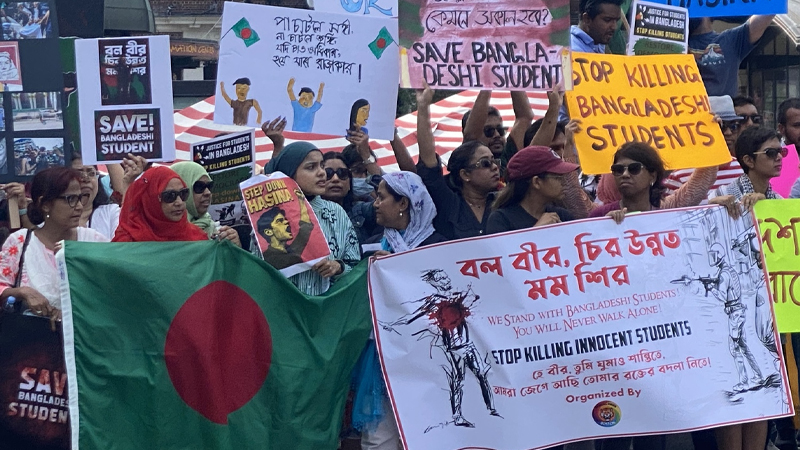
At least 300 people have died in clashes in Bangladesh, with 94 people killed on Sunday, making it the deadliest day in recent weeks of anti-government protests. The protests started in early July and have since intensified.
The count of the dead is based on reports from police, officials, and doctors at hospitals. More protests are expected on Monday. In the capital, Dhaka, soldiers and police are patrolling key roads and blocking routes to the prime minister’s office.
Hundreds of thousands of protesters are demanding Prime Minister Sheikh Hasina resign. On Sunday, they clashed violently with government supporters, using sticks and knives, while security forces fired rifles. Among the dead were 14 police officers.
Police reported that protesters attacked a police station in Enayetpur, killing 11 officers. “The terrorists attacked the police station and killed 11 policemen,” said Bijoy Basak, a deputy inspector general.
Journalists from AFP heard gunfire after dark on Sunday, with protesters defying a nationwide curfew. Mobile internet was also restricted.
In many cases, soldiers and police did not stop the protests, unlike previous rallies that ended in deadly crackdowns. A former army chief demanded the government withdraw troops and allow the protests.
In Dhaka, protesters waved a Bangladeshi flag on top of an armored car as soldiers watched. Asif Mahmud, a key leader of the protest movement, called for supporters to march on Dhaka on Monday, calling it the “final protest.”
Huge numbers of protesters, many with sticks, filled Dhaka’s central Shahbagh Square on Sunday. There were street battles in multiple locations. Police said two young men were killed in Munshiganj district, and two people were killed in Kishioreganj, where protesters burned a ruling party office.
Former military officers have joined the protests. Ex-army chief General Ikbal Karim Bhuiyan turned his Facebook profile picture red in support. He and other ex-officers condemned the violence and called for the withdrawal of armed forces from the streets.
Current army chief Waker-uz-Zaman said the army stands by the people and will help the state if needed.
The protests, which began over job quotas, have grown into a wider anti-government movement involving people from all walks of life. Some garment manufacturers have expressed support for the protesters.
Obaidul Quader, general secretary of the ruling Awami League, called on party activists to show their support for the government. Hasina has ruled Bangladesh since 2009 and won her fourth consecutive election in January, amid accusations of misuse of state power and suppression of dissent.






Leave a Reply