

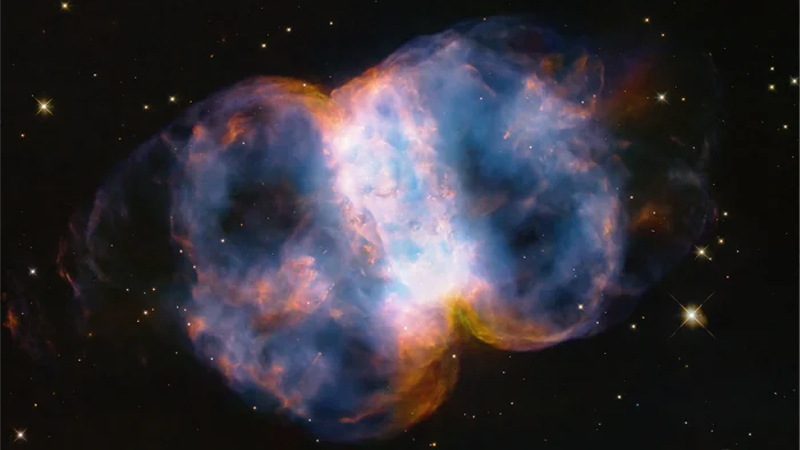
In a tribute to the enduring legacy of the Hubble Space Telescope, NASA has unveiled a captivating image of the Little Dumbbell Nebula, also known as Messier 76 or M76. The release coincides with the 34th anniversary of the iconic telescope’s launch, marking a milestone in its remarkable journey of exploration.
Launched on April 24, 1990, the Hubble Space Telescope has revolutionized our understanding of the cosmos, capturing breathtaking images and unraveling the mysteries of the universe. To commemorate this occasion, NASA treated space enthusiasts to a mesmerizing view of the Little Dumbbell Nebula, a celestial spectacle located approximately 3,400 light-years away.
The image depicts a vast expanse of glowing gas, reminiscent of a dumbbell, emanating from a colossal supernova. Researchers speculate that the nebula may provide clues to a cosmic drama, with hints of a star devouring its companion before embarking on its final stages of evolution.
Dubbed a planetary nebula due to its spherical shape, the Little Dumbbell Nebula bears resemblance to the disks from which planets are believed to have formed. First identified by astronomer Pierre Méchain in 1780, the nebula has since captured the fascination of astronomers worldwide, who continue to study its intricate details.
One intriguing question that lingers among researchers is the possibility of stellar cannibalism within the Dumbbell Nebula, a phenomenon yet to be fully understood. Despite the mysteries that shroud its origins, one thing remains certain – the Hubble Space Telescope has played an instrumental role in unraveling the secrets of this enigmatic cosmic entity.
At the heart of the nebula lies a remnant of the once-mighty star, now transformed into an ultra-dense white dwarf. With temperatures soaring to a scorching 138,871 degrees Celsius – 24 times hotter than the Sun – the white dwarf illuminates the surrounding gas clouds, casting a mesmerizing glow against the backdrop of space.
However, the beauty of the Little Dumbbell Nebula is transient, with experts estimating its eventual demise within the next 15,000 years. As it continues to disperse at speeds exceeding two million miles per hour, the nebula will gradually fade into obscurity, leaving behind a cosmic legacy imprinted in the annals of space exploration.
In a statement, NASA hailed the Hubble Space Telescope as the most scientifically productive space astrophysics mission in its history, underscoring its profound impact on our understanding of the cosmos. As the telescope embarks on another year of discovery, its legacy continues to inspire generations of astronomers, beckoning humanity to explore the vast expanse of the universe beyond.









Leave a Reply