

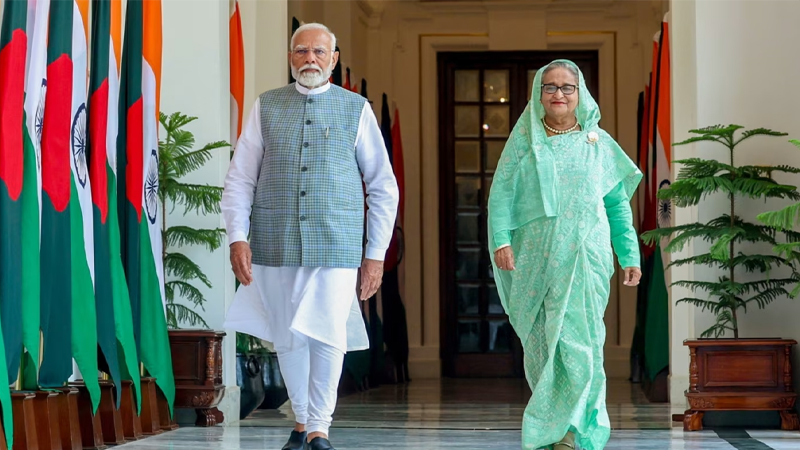
Sheikh Hasina’s rule has been marred by brutality against opponents, restrictions on freedom of expression, extrajudicial killings, and violations of minority rights.
Sheikh Hasina, the Prime Minister of Bangladesh, has often been criticized for her close ties with India’s Modi government. Many believe that her leadership has been characterized by cruelty, suppression of dissent, and violation of human rights, all while serving India’s interests.
Under her rule, Bangladesh has seen a significant erosion of democratic values. Opponents have been silenced through imprisonment, and freedom of expression has been severely restricted. For instance, political figures like Khaleda Zia and Mirza Fakhrul Islam Alamgir were imprisoned, reflecting a broader trend of suppressing political dissent—similar to the way Modi has reprimanded his political opponents.
One of the most alarming aspects of Hasina’s rule is the creation of the Rapid Action Battalion (RAB), a force that has been accused of widespread human rights abuses. Over 25,000 leaders have reportedly been arrested and tortured, with hundreds disappearing without a trace. This echoes the promotion of Hindutva ideology in India under Modi, where the RSS, a nationalist organization, has been linked to various violent acts.
According to Amnesty International, Sheikh Hasina’s government has used the Digital Security Act (DSA) to arrest over 56 journalists, aiming to stifle any critical voices. Similarly, in India, journalists have faced harassment, with 46 News Click journalists being charged with terrorism under dubious claims.
Both leaders have used internet shutdowns as a tool to silence their critics. In Bangladesh, internet services were suspended for over a month this year, while in India, the internet was shut down more than 800 times during Modi’s tenure. Additionally, between 2009 and 2024, Bangladesh recorded over 600 forced disappearances and more than 3,000 extrajudicial killings.
Modi’s influence has also extended beyond India’s borders, with over 20 extrajudicial killings reported in neighboring countries this year, leading to global condemnation. In July alone, over 300 students were killed, and more than 3,000 tortured in Bangladesh. Meanwhile, 255 incidents of violence against Indian Muslims were reported during Modi’s rule.
In Jammu and Kashmir, Modi’s government took away the region’s special status by revoking Article 370, further heating the market of cruelty and brutality.
The consequences of Sheikh Hasina’s actions are becoming increasingly evident. The very tactics she used to maintain power have turned against her, and now she faces growing opposition from her own people. Her reliance on Indian support may have helped her stay in power, but it has also deepened the suffering of the Bangladeshi people.



Leave a Reply